The Price of a Warm Bowl
A month inside a café where belonging is the currency
Read more →
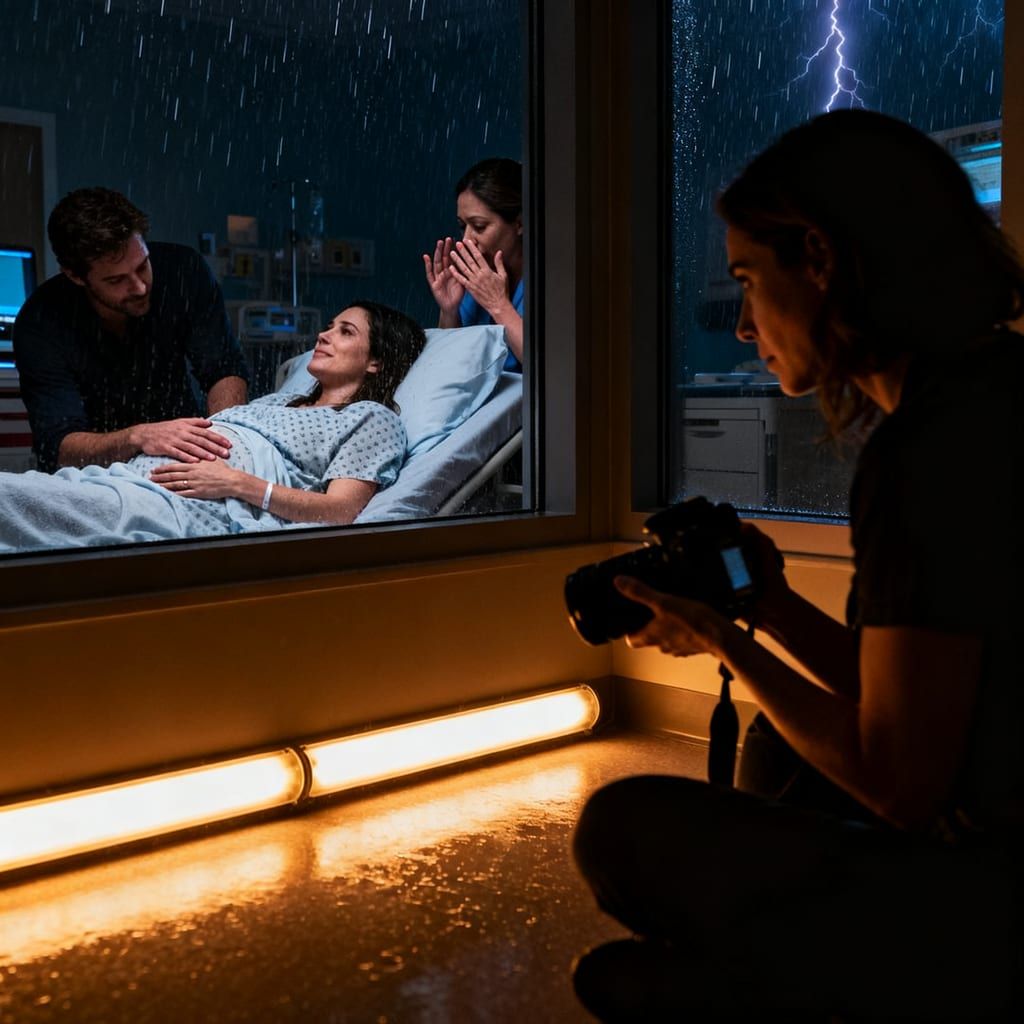
The thunder arrives before she does, rolling over the Schuylkill and folding itself into the hospital's glass. Lina parks beneath a licking streetlamp, rain scissoring the air, palms the spare batteries in her jacket pocket like a rosary-counting, reassuring. She doesn't trust the indicator light on her hearing aids anymore; it lies kindly, then flickers out mid-sentence.
She slings her camera bag over her shoulder and runs. By the time the automatic doors feather open, her bangs are a wet blade against her forehead. She presses her ID to the night guard's plexiglass, mouths "birth photographer" and lifts her camera as proof. He nods, the way people do when they can't quite make out the word but want to grant passage anyway.
On the elevator, the hum of fluorescent life surrounds her like a familiar ocean. Lina watches the rainfall lake on her jacket sleeve, watches it slip toward the cuff. She thinks of light-how it wants to be gathered. How it shows up even when asked softly.
Mara and Dev are already a room of motion when Lina enters: gloved nurses orbiting; a midwife with a braid like a rope; monitors stammering their steady poesy. But it's the couple that catches her breath. They talk with their hands, the language more rain than words-quicksilver and precise. Dev's palms move like birds. Mara's fingers bloom and fold, bloom and fold.
Lina rolls into the corner like she always does, becoming furniture-coat on the back of a plastic chair, bag under the sink, body slipping into the soft seam between curtain and wall. She raises the camera. The strap sings against her neck; the lens caps clack like teeth. She catches her reflection in the black square of the TV and sees her own hands, still as teaspoons.
The midwife signs as she speaks, voice pitched for the hearing nurse but hands for Mara and Dev. Lina doesn't know ASL beyond "thank you," "yes," and "wait," but she knows rhythm. She can read the music of the room-how Mara leans into a contraction like a swimmer into a wave, how Dev plants his feet and becomes shore.
Dev looks over and signs to Lina, then points to her camera. A question slants his eyebrows. She answers with a nod, lifts the camera halfway-May I? He gives a small half-smile that lands squarely in his eyes.
The rain thickens. Lightning scratches a white seam somewhere out beyond the blind. When the power stutters and falls to its knees, the monitors hiccup, then return as if waking in someone else's bed. The overheads don't recover. Emergency strips light the room from the floor up, a honey-colored tide pooling against the baseboards.
It is better light. Softer. The kind that leans in.
Lina adjusts her ISO, the muscle memory old and sure. She takes a test shot-a nurse's hand on the rail, the gleam of moisture on Mara's lip-and the screen gives back amber and grain, breath and skin. The hum in the room shifts; the thunder tick-ticks against the windows like a fingernail on glass.
Her left aid chirps-one sharp note like the edge of a birdcall-then drowns. The right follows, a courteous funeral. The soft tool she keeps in her ear canal suddenly feels like a rock.
For one heartbeat, panic is a physical thing. It stands, taps her on the sternum like an impatient friend. The spare battery is in her car, tucked into a coin slot, across a parking lot now turning river. The door credentials will not care that she's wet or late. The baby will not wait.
If you can't hear the first cry, a voice like a childhood teacher whispers, you'll miss the point.
Lina looks up. Mara's face is a shore under storm, open and earnest. Dev's hand spans her lower belly, feeling what she can't hear-the rise, the letting-go. The fetal monitor's green line translates pulse to light, a little city skyline breaking and rebuilding itself every second. Breath shows itself in the flutter of Mara's nostrils, in the way her toes flinch against the sheet with each swell.
They didn't ask for sound, Lina remembers. They asked for presence.
She slides the hearing aids out, two small moons cupped in her palm, and puts them carefully into the padded pocket of her bag. The absence isn't empty. It's warm, like a room whose radiator is working just right. The hospital's omnipresent hum thins to a thread. The rain becomes a silver flicker at the edge of her vision.
Without the thin commentary of machine and hallway, other things grow loud: the texture of sheets under knuckles; the climb of shadow along Dev's jaw; the way the emergency lights sculpt everyone into chiaroscuro saints.
Lina slows. She trades shutter bursts for longer exposures, the camera cradled like a sleeping animal. She braces her elbows on the bed rail, drops her breath into her belly, becomes metronome. Click-two-three. Click-two-three. The image of Mara's hand around Dev's finger opens on her screen like a secret she's been allowed to keep.
The midwife's hands narrate with calm economy. Dev answers, palms forward, then reaches to rub small circles above Mara's pubic bone. It is not a grand gesture. It is patient as bread rising.
Through the floor, a vibration tickles the bony plate at the center of Lina's chest. She presses her sternum lightly to the metal foot of the bed and feels the rhythm shift-between surges, down, then a steadying. The baby makes itself known as a current.
Mara grits her teeth, then unclenches. Dev slides behind her, his knees flanking her hips, his mouth against her temple. He laughs-Lina can see it without the sound, a small explosion that starts in his shoulders and shakes the air between them. Mara answers with a look that is language enough.
When the baby crowns, time doesn't slow so much as widen. The midwife's braid swings. The nurse folds a towel as if it matters-which of course it does. Dev's hands stop in air then land, unsure of where to be and deciding on everywhere.
Lina is in the doorway to the hallway and the low light and the rain's faint strobe. She doesn't look for the cry with her ears anymore. She watches Mara's face open-astonishment, pain, a wordless something-then watches it close around a new thing. She looks at Dev, whose mouth has fallen soft, the bones of his skull visible in the honeyed glow. His eyes hold something like praise.
And then the baby's body is here, a slick, blinking punctuation. The midwife holds the small weight to Mara's chest. The room blooms into motion: cloths, cords, a clamp that flashes like a silverfish.
Lina can't hear the sound that has always anchored these moments in movies and memories. But her sternum hums. The floor plank beneath her heel transmits a small, bright shiver. Dev's jaw trembles, then steadies. Mara says something with her eyes that makes the midwife's face soften in reply, and Lina gets it-gets all of it-like catching a hummingbird between palms and letting it go, startled and alive.
Two days later, the storm is a story the city tells in puddles. Lina sits at her kitchen table, the sunlight washing the wood soft, and edits with her hearing aids folded in their little velvet mouth. The apartment is not silent. The neighbor's laundry sighs; a bus leans into a stop. But inside, there is a lake stillness.
Frame by frame, she builds a short film. Hands. Breath. Rain as a blurred veil across a window. The emergency lights laying a path like melted amber. The fetal monitor's green city blinking. She cuts in the long exposures close together so the movements look like memory-slower, richer.
She writes to Dev and Mara, asks if they might share the baby's recorded heartbeat. Dev replies with a thumbs-up emoji and a file. Later he sends another message: "Want help turning it into light?" and a winking face.
They meet in a café where the music is too loud for Lina in some frequencies and a rumor in others. Dev opens his laptop and shows her software that turns waveforms into color bands. He drags a slider and the line becomes oceans of blue. He drags another and it becomes heat, oranges and reds licking upward.
He pulls a device from his bag, small as a matchbox, straps it to his wrist, and turns it on. A gentle thrum lands against his bones. He watches her watching. "Metronome," he mouths, then fingers the sign for heartbeat, tapping his chest with a curved hand.
She touches the device as if it might be hot. It is just warm, consistent. "For you," he says with his mouth this time, careful, and presses it into her palm.
Lina closes her eyes. The baby's heartbeat on her screen builds a curtain of light, pulsing. The metronome whispers against her skin. She considers all the ways she has made herself smaller to be allowed at the edge of beginnings. She opens her eyes to Dev's attention-soft, curious, not pitying.
"Did you-" she begins, then pauses, and signs the only way she knows. She taps her heart. She spreads her fingers open. "Feel it?" She mouths and signs at once.
Mara's hand finds Dev's on the table. "Yes," she signs. "We felt you feel it."
Lina laughs, and the sound surprises her. It comes out brighter than she expects, like a bolt on a cloudy afternoon.
When she delivers the images to their apartment-a narrow rowhouse smelling like warm rice-Mara's mother cries quietly, her hands fluttering at her throat like moths. The baby snuffles in a sling against Dev's chest, small fists opening and closing as if learning the word "more."
They don't ask if the first cry sounded beautiful. They ask if she felt it. Lina sets her palm, briefly, over the baby's back where the bones are soft and the heat is fierce, and nods. She tells them the truth then-about her hearing, about the rain, about the moment she put the aids in her bag and didn't reach for the door.
Dev grins, signs slow so she can follow: "Welcome," he says, palms tracing the shape of an open circle. "You can be here too."
On her way home, the sky sinks into a purple bruise, and the trolley wires sing-at least, they seem to. Lina goes up her stairs like someone carrying a recipe she can't wait to try. She opens her website and writes a small new line beneath her packages: Silent Sessions available-presence-forward documentation for all kinds of beginnings.
She doesn't explain. She doesn't need to.
Weeks later, a labor starts at 4 a.m. A second-floor walk-up in South Philly, a midwife with espresso in a thermos, warm water running in a tub that rocks the tile with its gentle body. The blinds tremble with every breath the house takes.
Lina arrives in boots, her hair braided to keep from her eyes. She greets the couple softly, palms against her chest, then asks with a gesture if it's alright to shoot. They nod. She watches the midwife touch the laboring person's ankle and count silently with rocking fingers. She feels her sternum meet the floorboards, the city under that, a train farther than thought.
She slips her hearing aids out and sets them on a folded towel by the sink, deliberate, like a ritual she's earned. The room answers, not out of pity or performance, but because that's what rooms do when asked softly. The blinds tremble. The kettle sighs on the stove. The breath in the tub makes a tiny, visible tide.
Lina raises her camera and becomes smaller and truer all at once. She trades noise for knowing. She times her inhales with the sway of the laboring body, lets the metronome on her wrist hum a path through her bones. The light is weak and perfect. In this dawn, even silence has texture-threads, velvet, the fine grit of something about to become.
Her lens fills with hands, with the small geography of a life about to begin. She feels the room arrange itself around the center of what matters. Nobody asks what the first cry will sound like. There will be a first cry, somewhere in the weave. But by the time it arrives-if it arrives-Lina will already have the better thing.
She will have the transfer, the belonging passed like a candle's flame from one set of hands to another, bright whether or not it says a word.

Story audiobooks for children of all ages — a new one every day on Smarter Way Stories.