One Quiet Round
On Mondays, they learn to turn toward the force
Read more →
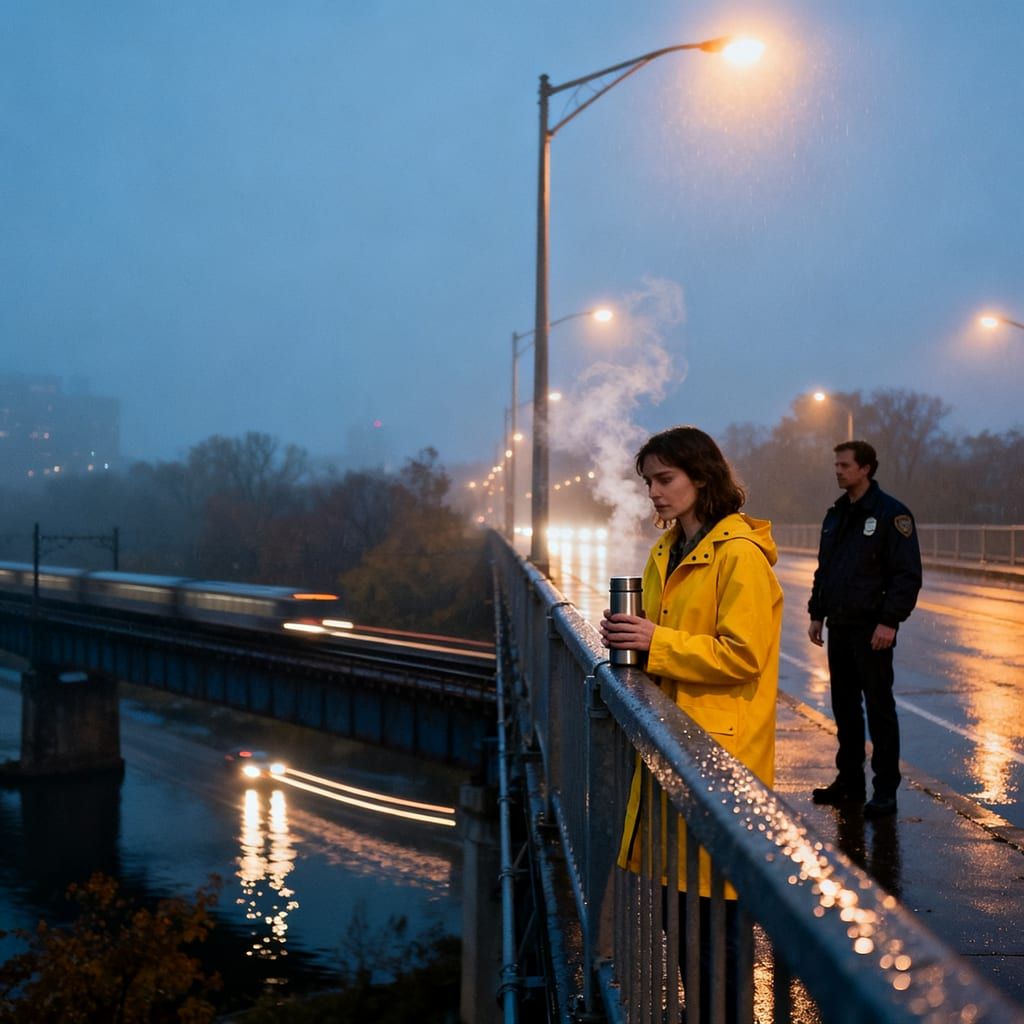
The bridge holds the last of the night like a breath. River below-black glass braided with ribbons of headlight. Wind rubbing the railing, a cold finger at the neck.
Elias parks without sirens. Lights off. He takes the thermos from the passenger seat, palms the dent where he once dropped it on concrete. Chamomile lives inside-apple-sweet and warm-and even before he sees her, he knows the weight of it is part of what he can offer.
A woman in a yellow raincoat stands on the wrong side of the railing. Toes on a seam of rust, heels hovering. Her phone lies facedown near a drain, a cracked star in its glass. The world smells like river metal and wet leaves.
He steps close enough to be heard without making the bridge vibrate. "My name is Elias," he says, which is how he always starts. "I'm here to be with you."
Her hood turns slightly. Just the glancing measure of him. "Of course you are," she says. Voice steady in the way paper is steady until it tears.
He doesn't ask why. Not first. The why is a story and stories take breath.
"Do you feel the wind," he says, "on your cheek-the left one more than the right? It has a little bite to it." He rubs his own cheek, so she can borrow the motion.
She hesitates. The slightest nod. "Yeah."
"And the bar under your hands-cold? Is there grit?"
She flexes her fingers on the rail. "Cold. Gritty."
A city bus moans across the far lanes. Its weight makes the guardrails hum. He waits for the hum to fade.
"I'm not here to pull you anywhere," he says. "Only to help find a place we can stand together. Would it be okay if we breathe once, on purpose?"
Her shoulders lift. Lower. Tight, then less tight.
"There's a box I like," he says. His voice knows this road. "In for four, hold for four, out for four, hold for four. Not a test-just something to do with the air. Want to try it with me?"
She doesn't answer. He counts anyway, no numbers-just the pace of a person crossing a room to a familiar chair.
In. Hold. Out. Hold.
By the third square, her hands are less claws and more hands. The hood tilts back an inch. Streetlight throws a small gold under her chin.
"What's your name?" he asks, and waits.
She swallows. "Lark." The name lands between them-tilted, possibly false, but alive.
"Lark," he repeats. He puts the thermos on the concrete by the base of the rail. Shows his palms. "I brought chamomile. No heroics. Just warmth, if you want it."
"I don't drink tea," she says, but the sentence sounds like a habit she forgot to examine.
They breathe again. Cars move like bad dreams. Somewhere beneath the bridge a train rehearses its metal rattle, shy of daylight.
"What would be a small, safe thing we could do next?" he asks. "Not a big choice. Just... the next inch."
Her laugh is quick and mean at herself. "I'm good at this," she says. "With other people. I'm the one with the clipboard and the soft voice, the one who says, 'Let's just put your feet on the floor.'" She tips her chin toward the water. "Turns out I hate the floor."
"Okay," he says. "Hate is information. We can work with information."
Wind lifts the edge of her hood. A strand of hair patterning against her cheek. He thinks of his wife, Talia, hair like a river in the morning when she slept in. The emptiness on his side of the bed a mapped country he studiously avoided naming.
Lark says, "There was a patient. He coded on my watch. I did the dance. Chest, meds, shocks. We got him back for a second on the monitor and then nothing. Family in the hall with their hands praying at air." She grips the bar harder. "There's an investigation. Words like 'protocol' and 'timeline.' I'm a hallway echo with legs."
Elias nods. He meets the words without flinching. "That is heavy."
"I can carry a lot," she says. "Until I can't."
He doesn't put a solution in her mouth. He offers a question that can hold the weight without slipping. "What do you need right now that isn't a decision about forever?"
She stares at the river as if it's a blank form waiting for her signature. "To not be inside my body."
"Okay," he says. "We can put some space in there. Would you try this with me? Notice the cold on your right hand. Notice the seam of your coat on your wrist. Notice the sound of the-" He listens. "Train under us?"
The train obliges with a new rattle. She closes her eyes, opens them. A damp brightness there, unfallen.
"That's it," he says, and wipes the praise from his voice before it can sour. "We're just letting sensations be louder than the fear for a minute. It's a pause, not a conclusion." His mouth knows the phrase before his mind remembers why.
Her head snaps slightly, like a bird hearing its own call. "What did you say?"
"A pause, not a conclusion," he says. "Words I learned a long time ago."
She repeats it, syllable by syllable, as if biting a thread free. "A pause, not a conclusion."
The wind drops. The bridge listens.
"When I was sixteen," Lark says, voice going softer and clearer at once, "I called a crisis line. Rain on the window. The room smelled like my mom's cigarettes in the curtains. I was trying to read the poster above my desk without turning on the light. Black-and-white photo of a girl in a field, hair like a curtain. The man on the line asked me if the girl in the poster had a name." She swallows. Her hands remember the bar under them and hold anyway. "He said, 'Let this be a pause, not a conclusion.'"
He feels it then-some bell rung long ago finally making its way back through the corridors he'd bricked over. That night in the cramped room at the hotline, burnt coffee and rain, a teen voice like a puddle you can't see the bottom of. He'd asked about the poster because there was nowhere else safe to go.
Elias looks at her-not too directly. No bright theater flourish. Just the sincerity that has saved him more times than training. "I used to work nights on a hotline," he says, carefully keeping it simple. "Years back. I remember that phrase. I used it because somebody gave it to me, too."
She laughs once, startled, and the laugh blows a tear loose. "You asked me if the girl had a name. I decided she did. I called her after the bird that can sing in storms."
Lark.
The recognition doesn't explode; it settles. A screw seating into threads. He feels his voice steady, as if a hand had come to rest at the center of his back.
"You've been through storms," he says.
"So have you," she says, and he can't hide how the words land.
"Here's a thought," he offers, gentle as laying a blanket over a sleeping child. "Would it be okay if we make today another pause? We don't write the ending here. We just write the next line. You take the tea if I hold the cup, and you step back to the sidewalk while you drink."
Her jaw works. She glances at the drop, at his empty hands, at the thermos. "You hold it," she says. "And don't say anything for ten seconds."
"Deal."
He kneels, slow, unscrews the thermos cap. Steam ghosts up, honey and apple and the breath of summer unrolled. He pours into the lid, no squeak of metal, then stands and lifts it to where she can reach without shifting her feet.
They count a silent ten. In that span, a gull somewhere complains; a truck shifts gears like a sigh; his phone vibrates once in his pocket, probably dispatch, probably his captain, probably a text he won't check.
On eight, she moves. Not heroic. Not cinematic. Just the careful reversal of a bad decision-one leg, then the other, heel over, sole on concrete. The rail stays between them, new now in its witness. When both her feet are on the safe side, he extends the cup.
Her hands shake. Tea licks over the rim onto her knuckles. She doesn't flinch. He is close enough to feel her breath warm on the cooling steam.
"Sit?" he asks, after the first swallow. "Curb's not much, but it's a place."
They edge down to the paint-chipped curb, backs to the guardrail, knees almost touching, the city fanning itself awake in their periphery. The river smuggles light east.
They sit in the long exhale. She cradles the empty lid. He caps the thermos and sets it between them like a small stove.
"Do you ever listen to your own advice?" she asks, staring at her knuckles as if reading palm lines in spilled tea.
He lets honesty be as small and as complete as a drop. "I'm learning."
He takes his phone out, thumbs stupid because the old fear is back-the one where the truth makes something worse before it makes anything better. He opens a message thread he hasn't touched in three weeks. Talia's last text: a picture of the dog sleeping on his side of the couch, captioned, "He still waits for you."
He types, erases, types again.
I'm on a ledge too. I want to talk.
He doesn't send it right away. He lets it sit in the air between them, a different kind of bridge.
"What's the smallest honest thing you can do when you get home?" he asks Lark.
She says, without dramatics, "Call my supervisor before she calls me. Ask to schedule a meeting. Ask for a session with the hospital's grief counselor. And..." She considers, a funny snort at herself. "Tell my sister I'm not fine."
"Those are three inches," he says. "Maybe four."
"Maybe." She looks at him sideways. "And you?"
He presses send. The message goes. The small circle rotates, becomes a checkmark, becomes a little blue. He exhales like someone set down a box he'd been carrying without awareness of its weight.
"I'm filing for decompression leave," he says, tasting each word like it's something warm from a pan. "Mandatory, this time. Paperwork today. I have a form already. I keep telling rookies to use it like a life jacket. Guess I'll take my own swim."
She grins, the first face of anything like joy. "Look at us. Overachievers at not concluding."
Somewhere, the train clatters again, deeper now, as if the city itself is clearing its throat. Dawn unspools a ribbon over the water. Cars hiss with the knowledge of wet pavement.
The radio on his shoulder murmurs his callsign. He taps it on but doesn't answer yet. The world can wait the extra breath it costs to pivot a life.
They stand. Stretch. The river keeps going-faithful, indifferent, generous. He offers the last of the tea. She shakes her head, hand up, then reconsiders and takes the final mouthful, grimacing at the sweetness he'd added to tempt a stranger.
"Too much honey," she says.
"Noted," he says.
Dispatch calls his name again, quieter this time.
They walk toward his car together, not touching. At the hood, she stops and pulls out her fallen phone from his pocket where he'd tucked it earlier with a nod. The spider crack is a small continent. She thumbs it awake.
"Meeting at nine," she says after a minute, looking a little surprised at her own follow-through. "Grief counselor at two." She blows out a breath that fogs her screen and vanishes. "My sister's getting a 6 a.m. call she'll never let me forget."
He holds up his own screen-Talia's three dots appearing, disappearing, appearing again. Then a reply: I want to talk too. When?
He doesn't answer that yet. He tucks the phone away like a letter you read twice before responding.
They stand without hurry, the bridge at their backs, the city reluctantly admitting morning. No one is fixed. No one is finished. Their feet point in the same direction.
When he finally keys the mic and tells dispatch he's clear, his voice is easy. He can almost hear the bell, far off but strong, still ringing.
Later, after the forms and the calls, after the second cup of tea poured at his own kitchen table, he will think about how some sentences take years to circle back, and how they sound when they do-not like rescue, but like returning to a road you've walked before, finding it still holds.
For now, the river takes the first light the way paper takes ink. Pauses bloom into lines. The rest can be written.
On Tuesdays, Noor walks through a corridor of shouting and finds the pulse beneath it
Read more →Story audiobooks for children of all ages — a new one every day on Smarter Way Stories.